
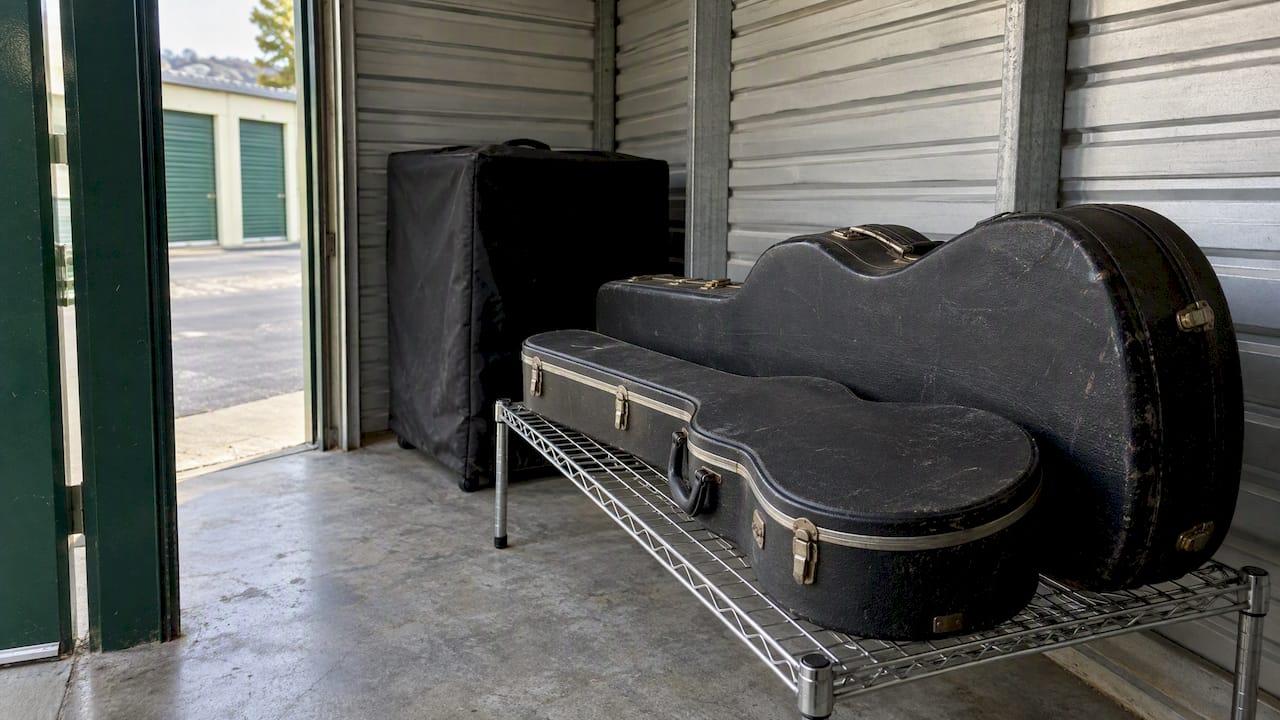
The best way to store a musical instrument is in its case, in a stable, moderate space, with string and drumhead tension eased off, up off the floor and away from sun, damp and big temperature swings. Get those basics right and your guitar, sax or snare will come out of storage the way it went in. Below, we walk through the prep, the numbers makers recommend, how to pick a unit size, and a quick word on storing a fridge, since plenty of you are packing one of those too.
TL;DR
- Keep instruments in a good, fully closed case in a stable climate. Avoid attics, basements, direct sun and big swings in heat or humidity.
- Ease tension, don’t remove it: slack strings left in place, flat but not taut drumheads.
- Makers’ guitar guidance runs roughly 40 to 55% humidity. Check your own maker’s care guide for the exact range.
- Keep everything off the floor on pallets or risers, with room for air to move.
- Need space? We rent month-to-month units with no deposit, 24/7 gate access and an on-site manager, seven minutes from downtown San Francisco.
Table of Contents
- Why instruments are fussier than boxes of books
- Prep before you pack
- The numbers: temperature and humidity
- Guitar-specific tips
- Other instruments, quick hits
- Home vs. a storage unit: what to check
- Picking a unit size for your gear
- Perspective
- Reserve a unit for your gear
- What about the fridge and other appliances?
- Handy reads if you’re storing more than music
- FAQ
- Sources
Why instruments are fussier than boxes of books
A box of sweaters doesn’t care about a damp week. A violin does. Most instruments are built from wood, glue, felt, leather and metal, and those materials all react to the air around them.
Conservators at the University of Delaware explain that temperature and humidity swings make instrument materials expand, contract and warp, and that full playing tension magnifies the stress. That is the whole reason “just toss it in the garage” goes badly.
A classic museum-storage paper puts the wood problem plainly: when humidity changes, wood swells or shrinks, and fast drying can crack it or open joints because different parts shrink at different rates. Cracks and open seams are not a quick fix. So the goal is simple: keep things steady.
Prep before you pack
Ten minutes of prep saves a repair bill. Here is the routine we’d follow.
- Wipe it down. Use a soft, lint-free cloth. The Delaware conservators suggest wearing gloves when handling instruments and avoiding bare-hand contact with metal, since skin oils and sweat can mark it.
- Ease the tension. Same source: reduce tension, don’t eliminate it. Strings stay in place, straight but slack. Drumheads stay flat but not taut. Assembled woodwinds should have a little movement at the joints.
- Case it. Use a case in good condition and close it fully. Opportunity Music Project recommends keeping each instrument in its own fully secured case.
- Pad the gaps. If the case has extra room, fill it with soft foam or archival tissue so the instrument can’t shift.
- Cover what won’t fit a case. Amps, keyboards and drum shells do fine under a breathable cover that keeps dust and light off.
- Get a pro look first if something’s off. A buzzing fret, a sticky pad or a loose bridge is a job for a repair tech before storage, not after.
The numbers: temperature and humidity
Everyone wants a magic number. There isn’t one, because makers disagree a little. Here is what the manufacturers and educators say:
| Source | Temperature | Humidity |
|---|---|---|
| Martin Guitar care guide (2022) | 72 to 77°F | 45 to 55% |
| Alvarez Guitars | 66 to 77°F | 40 to 50% relative humidity |
| Opportunity Music Project | Not specified | About 40%, never below 30% |
The pattern is clear: comfortable room conditions, with humidity in the middle of the range, and no wild swings. If your instrument came with a care sheet, that sheet beats any table, ours included.
Two more rules that apply to nearly everything:
- Keep it out of direct sun and rain. Both are on the Opportunity Music Project’s no-go list.
- Let a cold instrument warm up slowly. Opportunity Music Project suggests letting it warm gradually before you open the case. That keeps moisture from condensing on cold surfaces and avoids shock to finishes.
Guitar-specific tips
Guitars are the most-searched instrument for storage, so here’s the short list.
- Case it and detune a little for long stretches. Martin says to slightly detune stringed instruments for extended storage to take tension off the neck, bridge and top.
- Skip exterior walls in winter. Yamaha warns that hanging a guitar on an exterior wall in winter can cause damage, because the top and back end up at different temperatures.
- Keep heat sources away. Martin’s guide says to keep guitars away from heat sources, too.
- Use humidity control when the air is dry, cold or damp. Alvarez recommends appropriate humidification in those conditions. Ask your guitar’s maker what product they suggest.
Hanging wall cases look neat in a spare room, but for moving or storage the hard case is your friend.
Other instruments, quick hits
Brass and woodwinds. Swab, wipe, and keep them in the case. Metal fingerprints are a real thing, so gloves help. Don’t clamp every joint down hard; leave a bit of play when stored assembled, as the conservators suggest.
Drums. Loosen heads so they sit flat, not taut. Pack cymbals and hardware separately so nothing leans on a shell. Stack shell bags, don’t crush them.

Keyboards and amps. Cover them, keep them off the floor, and don’t stack heavy things on top. Coil cables loosely.
Pianos. Big, heavy and fussy. A piano store, Ogden Piano Gallery, advises that instruments should never sit directly on concrete or tile. Raise them on platforms, risers or pallets so air can move and moisture isn’t absorbed. Use professional piano movers, always.
Violins, violas, cellos. Slack strings (not removed), keep the bridge and soundpost in place, and use a well-padded hard case. Take them to a luthier with questions.

Home vs. a storage unit: what to check
Storing at home is fine when you have a spot that fits the bill. Delaware’s conservators recommend a moderate, stable climate, such as by an interior wall in a cool room, and they steer you away from attics, basements, humid kitchens and bathrooms.
Ask yourself:
- Is there a closet against an interior wall that stays an even temperature?
- Is there space for the case without stacking things on it?
- Does the spot ever get damp, hot or sunny?
- Are you tripping over an amp every day?
If the honest answer is that your place is packed, roommates are complaining, or you’re moving across town, a unit is the sensible answer. And the length of your stay matters. For a few weeks or a summer, a case plus a sensible prep routine does the job. If you’re planning three months or more, read our guide on when climate controlled storage pays so you can weigh what your instrument needs against your budget.
Talk to us about what you’re storing and for how long. We’d rather point you to the right setup than sell you the wrong one.
Picking a unit size for your gear
Here are our current published monthly rates for self storage units, so you can size things up. These are starting points for planning, not guarantees of fit, so measure your biggest case first. Our own 5×10 sizing guide explains why measuring the door matters.
| Unit | Price | Rough idea of what fits (our suggestion) |
|---|---|---|
| 2×3 | $29/month | A small amp, pedals, a stack of cases’ worth of accessories |
| 3×4 | $55/month | A few small cases and a keyboard in its bag |
| 5×5 | $79/month | Several guitars in cases plus an amp |
| 5×8 | $115/month | A small band’s gear, minus the drum kit |
| 8×10 | $179/month | A full drum kit, amps, PA and cases |
Larger sizes (8×20 at $279/month and 8×40 at $399/month) are there for studios, music schools and people hauling a whole rehearsal space. You can see every size on our units page.
A few packing habits make any size work better:
- Raise everything off the floor. Pallets or risers, as above.
- Heavy at the bottom, delicate on top and to the side. Never stack on a case that holds an instrument.
- Leave an aisle. You’ll want to grab a case without moving four others.
- Label cases. “Dad’s trumpet” beats a guessing game.
- Keep a printed list of serial numbers and photos of each instrument.
On that last point, if your gear is valuable, read our take on what self storage insurance you need and what you can skip. It’s also worth reading how storage unit security works, including your own lock.
Perspective
We run a drive-up facility, so we see the whole range: the weekend guitarist, the student heading home for summer, the contractor who also plays bass and needs a spot for the amps.
Here is what we tell people. Instruments mostly want one thing, which is steadiness. So prep well, case everything, and get it off the floor. Then pick a unit that makes life easy for you. With true drive-up access, you pull up, load the case straight from the car and you’re done. No elevators, no carts, no bumping a cello into a hallway wall.
Our units are month-to-month with no deposit, and the gate is open 24/7. So if there’s a last-minute gig and you need your rig at 11 p.m., you can get it. And if a stay turns out shorter than planned, you aren’t locked into anything. We’re seven minutes from downtown San Francisco with no city traffic, and a manager is on site, so you can ask questions in person. Bring us your gear list and we’ll help you choose a size.
Mike
Reserve a unit for your gear
If you’re ready to move your instruments out of the spare room, we can set you up. Our self storage units run from 2×3 at $29 per month up to 8×40 at $399 per month, all month-to-month with no deposit and 24/7 gate access. See sizes and prices on our units page and reserve the one that fits.

Need a truck for the move? We also rent U-Haul trucks from $19 per day and sell boxes and moving supplies at our main site.
What about the fridge and other appliances?
A lot of you are packing a fridge alongside the guitars, so here’s the quick version. Before a long absence, GE’s owner guidance says to remove the food, unplug the refrigerator, clean the inside with a baking soda solution and leave the doors open. That keeps odors and mold from setting up in a closed box. Check your own model’s manual for details, especially about moving it upright.
For other appliances, the same logic applies: clean, dry, empty, and easy to open. Your manual is the best guide for each one. Keep cords tucked and pack small parts in a labeled bag taped inside.

Handy reads if you’re storing more than music
People rarely store just one thing. A few of our other guides may help:
- Art storage month to month, for canvases and frames.
- Student summer storage options, if you’re a student heading home.
- Motorcycle storage in San Francisco, for two-wheelers.
- Holiday decoration storage, for fabrics and keepsakes.
- More tips on our storage and moving blog.
FAQ
What is the best way to store musical instruments?
Put each one in a good, fully closed case, in a stable and moderate space away from sun, damp and swings in temperature. Ease tension without removing it, pad any extra room in the case, and keep everything off the floor. Check your maker’s care guide for exact humidity and temperature ranges.
How do I store a guitar for a few months?
Keep it in its hard case, away from heat sources and exterior walls in winter. Martin suggests slightly detuning it for extended storage, and both Martin and Alvarez publish humidity ranges of roughly 40 to 55%. Let it warm up gradually before you open the case after being somewhere cold.
Can I store a piano in a self storage unit?
It can be done, but plan carefully. Keep the piano off concrete on risers or pallets so air can move beneath it, and use professional piano movers. Call us before you reserve so we can talk through size and access.
How do I store a refrigerator?
Empty it, unplug it, clean the inside with a baking soda solution and leave the doors open, per GE’s guidance for long absences. Check your manual for how to transport it. We have drive-up units and U-Haul trucks for moving day.
Sources
- Attics and Basements and Closets, Oh My! Part 20: Musical Instruments (University of Delaware)
- Storage Climates for Musical Instruments (1982)
- Instrument Care, Opportunity Music Project
- Martin Guitar Care & Feeding guide (2022)
- Yamaha Instrument Care Guide: Guitars (2024)
- Caring for your Alvarez, Alvarez Guitars
- Prepare Your Piano for Storage, Ogden Piano Gallery
- GE refrigerator owner guidance